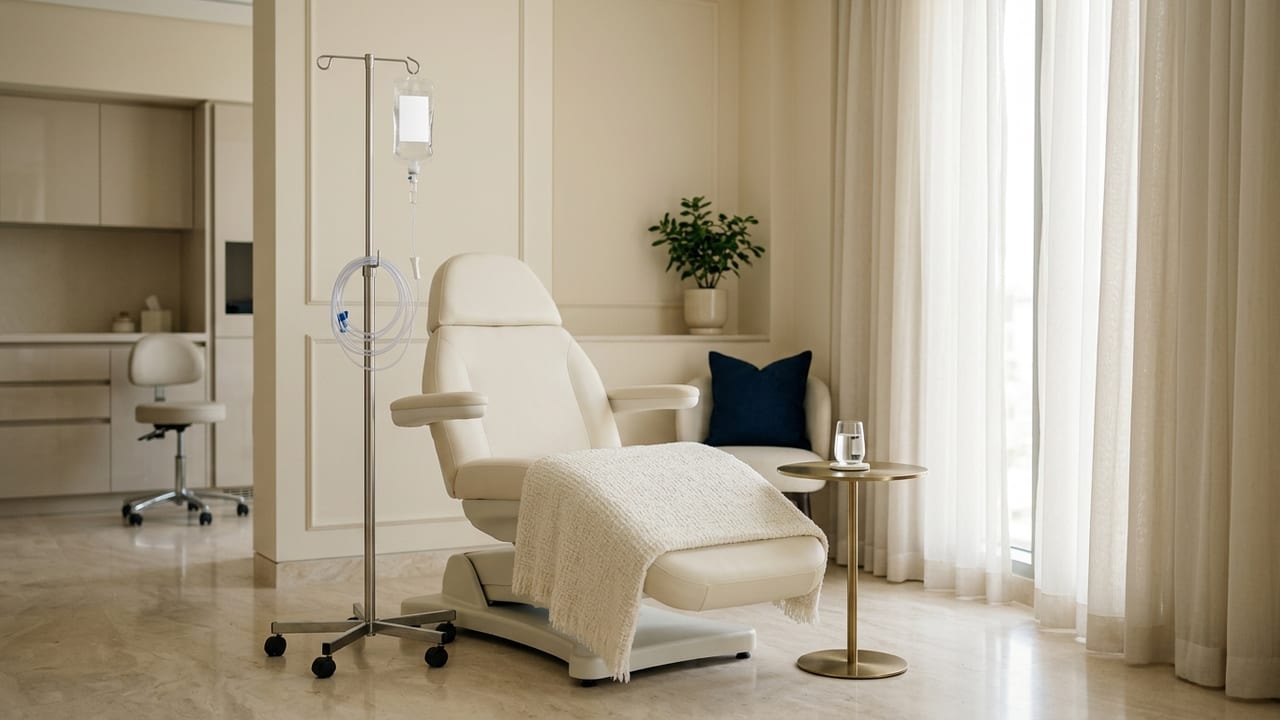
The short answer
- No regulator we could find approves injected glutathione for lightening skin. The US FDA has approved no injectable skin whitener, and in 2021 the DHA sent every private facility in Dubai a federal ministry warning on glutathione injections for skin treatment.
- The evidence is thin: the only placebo-controlled IV trial we found (50 women enrolled, 32 finished) showed no statistically significant benefit, and the small gain faded within six months.
- Published prices run from AED 299 to 2,599 per session in Dubai, with Abu Dhabi home-visit drips at AED 599 to 749 (October 2026). A 10-session course costs roughly AED 2,400 to 19,000 before maintenance.
- Serious side effects are real: anaphylaxis, abnormal liver tests, rare severe skin reactions and contaminated products. G6PD deficiency, kidney problems and pregnancy are reasons to say no.
- Dark spots and uneven tone have better-evidenced treatments. If you still want a drip, a doctor must prescribe it and a licensed facility or home healthcare provider must give it. Check the licence first.
- What a glutathione drip or injection is
- Is it approved? What regulators say
- Does it lighten skin? The trials
- Before and after: how long results last
- Dubai and Abu Dhabi prices
- Side effects and risks
- Who should not have it
- Better options for dark spots and uneven tone
- Licensing, home drips and questions to ask
Glutathione drips are among the most heavily advertised treatments in the UAE. Clinic menus call them whitening, brightening or glow drips, home healthcare companies deliver them to apartments and hotel rooms, and bridal packages bundle ten sessions before a wedding. The marketing is confident. The evidence, and the regulators, are far less so.
This guide sets out what you would actually be paying for. A note on language: the UAE market sells glutathione as "skin whitening". We talk about evening out tone and fading pigmentation instead, because a healthy skin colour is not a problem to be fixed, and because that is the honest limit of what glutathione has shown.
What is a glutathione injection or drip, and what is in the bag?
Glutathione is an antioxidant your body already makes from three amino acids, and a glutathione drip delivers a dose of it, usually 1,000 to 1,200 mg, into a vein over roughly 30 to 60 minutes. "High-dose" drips on UAE menus go up to 2,500 mg. Most come in a bag of 100 to 400 ml of saline, and many add vitamin C.
Clinics sell several routes under one name. A drip runs slowly through a cannula; a "glutathione injection" or "shot" is usually a quick injection into a vein or a muscle; some clinics inject it into the skin as a glow treatment. Combination drips add alpha lipoic acid, N-acetylcysteine, B vitamins or collagen, under names such as "Snow White".
The theory comes from laboratory work: glutathione is thought to block tyrosinase, the enzyme that starts melanin production, and to nudge pigment cells from darker eumelanin towards lighter phaeomelanin. The catch is getting it into those cells. In cell studies described in a 2018 review, plain glutathione did not reduce tyrosinase activity inside the cells; only modified, fat-soluble versions did.
Is glutathione approved for skin lightening? What regulators say
No. We could not find any regulator that approves injected or infused glutathione for lightening skin, and several have warned against it, including the UAE's own.
- United States. The FDA's consumer warning on injectable skin lighteners states that it "has not approved any injectable drugs for skin whitening or lightening". It classes them as unapproved new drugs, names glutathione and vitamin C among their ingredients, and notes a 2017 court order stopping a US company from distributing glutathione brands such as Tatiomax and Relumins.
- The Philippines, where "gluta drips" are widely sold, issued Advisory No. 2019-182. It says there are no published clinical trials of injectable glutathione for skin lightening and no dosing guidelines, that no injectable product is approved for lightening, and that injectable glutathione is approved only as an add-on during cisplatin chemotherapy.
- Saudi Arabia. The Saudi FDA warned in 2015 about unregistered glutathione whitening injections, including Tatiomax, Saluta and Glutax, sold through websites and social media.
- Dubai and the UAE. On 5 October 2021 the Dubai Health Authority sent circular CIR-2021-00000172 to all health facilities and practitioners in Dubai's private sector. It relays a Ministry of Health and Prevention (MOHAP) circular titled as a warning against using glutathione for dermatological treatment by injection into a vein, a muscle or under the skin, and asks facilities to adhere to it. We could not open the attached MOHAP document in full, and we found no later circular withdrawing it.
Many UAE pages describe glutathione drips as "approved". Ask exactly what is approved. A clinic can hold a valid DHA or DOH licence, and a glutathione product can be registered as a medicine for a medical use (in India, according to a 2018 review, IV glutathione is approved only for alcohol-related liver disease), without either one being approval to lighten skin.
Does glutathione lighten skin? What the trials actually show
For drips and injections, it has not been shown to work: the one placebo-controlled trial we found reported a difference that was not statistically significant and that faded within months. The cheaper oral and topical forms have slightly better, though still small, studies behind them.
| Form | Key study | Who and how much | What it found |
|---|---|---|---|
| IV glutathione with vitamin C | Placebo-controlled trial, Pakistan, published 2016 | 50 women enrolled, 32 finished; 1,200 mg twice a week for 6 weeks | 37.5% improved vs 18.7% on saline (p = 0.054, not significant); gains faded after stopping; 8 abnormal liver tests and 1 anaphylaxis among 25 treated |
| Oral capsules | Randomised, double-blind trial, Thailand, 2012 | 60 medical students; 500 mg a day for 4 weeks | Melanin readings fell at all six sites, but beat placebo at only two: the right side of the face and a sun-exposed forearm |
| Oral lozenge | Open-label study, Philippines, 2016 | 30 women; 500 mg a day for 8 weeks | 90% were rated moderately lighter, but there was no placebo group |
| 2% glutathione lotion | Split-face placebo trial, 2014 | 30 women; twice daily for 10 weeks | Lower melanin readings on the treated side; no follow-up after stopping |
Three things stand out. The most expensive route has the weakest result: with 16 women left in each group, 37.5% versus 18.7% is a difference of three people, and the authors concluded that glutathione was not very effective, that its effect waned and that side effects were common. The oral and topical changes were measured with a meter, and a lower melanin index is not always a change anyone would notice. And the studies are tiny, short and almost all in Thai, Filipino and Pakistani volunteers.
A 2019 systematic review of the four oral and topical trials available at the time found a possible brightening effect on sun-exposed skin, no significant change on sun-protected skin, and called the evidence inconclusive. A 2018 review in Dermatology Practical & Conceptual put it more bluntly: there is "little convincing evidence" for glutathione in hyperpigmentation, and heavy use, especially by injection, seems unjustified.
Before and after: what results look like and how long they last
At most, expect a subtle and temporary change, and treat dramatic before-and-after photos with caution. Lighting, camera settings, filters, makeup and season all change how skin looks in a photo. A course that begins after a sunny holiday, or alongside a new daily sunscreen habit, will often coincide with a tan fading on its own.
On duration, the IV trial is the only data we have: the share of women showing improvement dropped after the last drip, and six months later only one woman still had it. Your pigment cells keep working and Gulf sun keeps stimulating them, which is why clinic packages rarely stop at one course. One Dubai hospital's skin brightening package sets 10 weekly sessions followed by monthly maintenance, and another clinic suggests drips weekly or twice weekly.
You can stop at any time, including after three months; nothing about stopping is harmful, and your skin simply returns to its usual tone. If what bothers you is a specific mark or patch rather than your overall colour, a drip is the wrong tool. Most UAE residents have medium to deep skin (Fitzpatrick IV to VI), where the common concerns are melasma, sun spots and dark marks left by acne, each with treatments covered below.
How much does a glutathione injection cost in Dubai and Abu Dhabi?
Published prices in October 2026 ran from AED 299 to AED 2,599 per session in Dubai, mostly depending on the dose and what else is in the bag, and from AED 599 to AED 749 for home-visit drips in Abu Dhabi. These are the clinic and provider prices we could read directly on their own pages.
| What you are paying for | Where | Published price (October 2026) |
|---|---|---|
| Glutathione drip, single session | Business Bay clinic | AED 299 (four for AED 897) |
| Glutathione 1,200 mg drip, single session | Clinic group, Dubai and Abu Dhabi | AED 366 (list price AED 430) |
| Same drip in a five-session package | Clinic group, Dubai and Abu Dhabi | AED 278 a session (AED 1,390) |
| Glutathione plus vitamin C, 10-session package | Clinic group, Dubai and Abu Dhabi | AED 449 a session (AED 4,490) |
| Glutathione drip, home visit | Dubai home healthcare provider | From AED 499 |
| Glutathione drip, 1,000 to 1,200 mg | Another Dubai clinic | AED 999 to 1,499 |
| Glutathione plus vitamin C | Same Dubai clinic | AED 1,299 to 1,899 |
| High-dose drip, 1,500 to 2,500 mg | Same Dubai clinic | AED 1,899 to 2,599 |
| Glutathione injection (shot), per session | Same Dubai clinic | AED 499 to 1,599 |
| Home-visit drips: glutathione, with vitamin C, "skin whitening" | Abu Dhabi home healthcare provider | AED 599, 649 and 749 |
The session price is the smaller number. Because drips are sold as courses, the useful figure is the total. At the offer and package prices of the cheaper clinics above, 10 sessions come to roughly AED 2,400 to 4,500. At the highest published rates for glutathione with vitamin C (AED 1,299 to 1,899), the same 10 sessions would cost about AED 13,000 to 19,000. Monthly maintenance at AED 300 to 600 a drip adds AED 3,600 to 7,200 a year. That is planning arithmetic, not a quote.
Before comparing quotes, ask what the price includes: the dose in milligrams, every added ingredient, the doctor's consultation, any blood tests and the home-visit fee. Few price lists say. A price far below the market is also a reason to ask where the glutathione comes from.
What are the side effects and risks of glutathione injections?
Many people have no reaction or a mild one, but the serious risks are real: severe allergic reactions, liver and kidney effects, rare life-threatening skin reactions, and infection or contamination when the product or the setting is not what it should be.
- Minor effects. UAE clinic pages list nausea, dizziness, swelling and allergy, and any cannula can bruise or sting.
- Allergic reactions and the liver. In the IV trial, 8 of the 25 women given glutathione developed abnormal liver tests and one had anaphylactic shock, which is why they were withdrawn.
- Kidneys, nerves and skin. The Philippine FDA lists toxic effects on the liver, kidneys and nervous system, and the possibility of Stevens-Johnson syndrome, a severe blistering reaction. A 2025 US case report described a 33-year-old woman who developed it after an IV infusion of glutathione, vitamin C and vitamin D.
- The vitamin C in the bag. The same advisory warns that IV vitamin C can form kidney stones if the urine is acidic, and that large doses have led to dialysis in people with G6PD deficiency.
- Contaminated products. In August 2026 the US FDA reported at least 30 patients with fever, chills, signs of shock or sepsis-like illness after IV glutathione made from "dietary supplement grade" powder, which is not meant for injection. Some needed hospital care, and two pharmacies recalled glutathione injections for high endotoxin levels.
- Counterfeit and unsterile treatment. Regulators in the Philippines and Saudi Arabia warn about unregistered vials sold online, and about HIV and hepatitis spreading when non-medical staff give drips in non-sterile settings.
- Long-term unknowns. Because glutathione acts on melanin, the Philippine FDA describes "theoretical concerns" about long-term skin cancer risk. Nobody has studied repeated drips over years.
Never inject vials bought online, from social media sellers or from a salon. You cannot know what is in them or how they were made, and an IV line bypasses every defence your skin and gut normally provide.
Who should not have glutathione injections?
Some people should not have a glutathione drip at all, and everyone else needs a doctor's assessment first, not a menu choice at reception. On the evidence above, these are the situations that should stop or pause the plan.
- Pregnancy and breastfeeding. There is no safety data, and elective treatments are deferred for exactly that reason. Our guide to aesthetic treatments during pregnancy and breastfeeding explains the approach.
- G6PD deficiency. This matters more in the UAE than almost anywhere: in newborn screening data from 20 hospitals and laboratories across four emirates (2021 to 2023), G6PD deficiency was the most common condition found, at 5,278 per 100,000 babies, roughly 1 in 19. Many adults do not know their status, so ask for a test before any drip that contains vitamin C.
- Kidney disease or past kidney stones, because of the kidney warnings and the vitamin C risk.
- Liver disease or abnormal liver tests, given the liver findings in the IV trial.
- Asthma, especially if sulphites set it off. In a small 1997 study, inhaled glutathione caused marked airway narrowing in people with mild asthma, linked to sulphite formation. There is no comparable data for drips, but tell the doctor. Sulphite sensitivity differs from an allergy to sulfa antibiotics; mention either.
- A past reaction to any infusion or to any ingredient in the bag.
- Cancer treatment. Glutathione is used alongside some chemotherapy in certain countries, which is a reason not to add an antioxidant drip without your oncologist's agreement.
What works better for dark spots and uneven tone?
If what bothers you is pigmentation rather than your natural colour, the treatments with real evidence target the cause: daily sunscreen, prescription creams, gentle peels and carefully chosen lasers. In the UAE the starting point is almost always sun protection, because no treatment holds against year-round UV without it.
- Melasma, the symmetrical brown patches on cheeks, forehead and upper lip, is managed with tinted sunscreen and prescription topicals such as tranexamic acid and azelaic acid, and lasers are used cautiously because they can make it worse. See our guide on how to get rid of melasma in Dubai.
- Sun spots and photo-ageing respond to topicals, peels, IPL or lasers chosen for your skin type, as our guide on how to get rid of sun damage in Dubai explains.
- Dark marks after acne and general unevenness often fade with a series of gentle peels; mandelic acid suits deeper skin tones, as our chemical peel guide for Dubai sets out.
- Not sure which you have? Our overview of pigmentation treatment in Dubai matches each type of pigment to the treatments that suit it.
If the goal is glow and hydration rather than tone, licensed injectable skin boosters have a defined formula and clinical data behind them, which glutathione drips do not.
Licensing: who may prescribe and give a glutathione drip in the UAE
An IV drip is a medical procedure: it should be prescribed by a licensed doctor after an assessment, given by a licensed doctor or registered nurse, and delivered in a licensed health facility or by a licensed home healthcare provider. Facilities are licensed by the DHA in mainland Dubai, the DOH in Abu Dhabi and MOHAP in the northern emirates, with Sharjah and Dubai Healthcare City under their own regulators. A salon or spa should not be offering drips at all.
In Dubai, the DHA's cosmetic procedures standard does not mention IV drips, so the rules that matter are general medical ones and, for home visits, the DHA Standards for Home Healthcare Services, in force since 19 February 2025. Any service carried out at home falls under home healthcare, the facility needs DHA permission through the Sheryan platform, every professional must hold a DHA licence, and medicines are prepared and given by physicians and registered nurses, with assistant nurses only supporting. Home healthcare is meant for patients referred by a physician. One Dubai clinic page we read said no doctor consultation was needed for its drips; treat that as a warning sign.
So the usual rule that a home visit is a red flag for fillers and Botox needs a qualifier: a home drip can be legitimate, but only from a provider with home healthcare permission. In Abu Dhabi, the DOH home healthcare standard requires either a DOH licence for the service or an approved "add service" on an existing facility licence, with at least one physician and 25 registered nurses for a home healthcare provider. In either emirate, take two minutes to check the clinic's and the nurse's licence on the right registry, then ask:
- Which doctor will assess me and prescribe this, and will they review my medical history, medicines and allergies?
- What exactly is in the bag, at what dose in milligrams, and can I see the vial and its UAE registration?
- Will you test for G6PD deficiency before giving vitamin C, and check my kidney and liver function?
- Who will insert the cannula and stay with me during the infusion, and what is their DHA or DOH licence number?
- For a home visit: does your facility hold home healthcare permission, and what happens if I react?
- What change do you expect, by when, and what happens when I stop?
- Is the price per session or per course, and does it include the consultation and blood tests?
If you would rather not work this out alone, that is what we are here for. Tell us what bothers you about your skin, your skin type and which emirate you live in, and we will match you with licensed clinics that assess the cause first and quote clearly.
Pigmentation treatment in Dubai
Melasma, sun spots and dark patches, treated by cause.
SkinHow to get rid of melasma
Why it comes back, and the treatment ladder that keeps it controlled.
SafetyAesthetic clinic red flags
The marketing and consultation signs of a clinic to avoid.
TreatmentSkin boosters in Dubai
Licensed injectables for glow and hydration, with prices.